So your factory bed is not cutting it anymore. You have hauled loose gear enough, lost enough small parts down the side, and watched enough stuff get rained on to know something has to change. Now you hit the same fork that every truck owner does. Topper or rack?
If you have watched a few reviews, you already know both camps swear by their pick. That does not help much when you are the one writing the check. The truth is that truck topper vs bed rack is the wrong way to frame it for a lot of owners, because the right answer depends entirely on how you actually use your truck. A weekend camper and a full-time contractor are solving different problems with the same bed.
This is an honest, side-by-side look at both, weighed against what matters most: tool hauling, weather protection, gear stacking, and resale. By the end, you will know when each one makes sense, plus a third option most comparisons skip.
What a Truck Topper Actually Does
A topper, sometimes called a cap or shell, is an enclosed cover that sits over your bed and turns it into a sealed, lockable space. Think of it as adding a small room to the back of your truck.
Toppers do a few things well:
- Weather protection: Your gear stays dry and out of the sun.
- Security: A locked shell keeps tools and equipment out of sight.
- Enclosed space: Good for anyone who sleeps in the bed or hauls things that hate the weather.
The tradeoff is access. A topper seals the bed off, so loading tall or bulky items gets awkward, and you lose the ability to haul anything that does not fit under the shell. Once it is on, it mostly stays on.
What a Bed Rack Actually Does
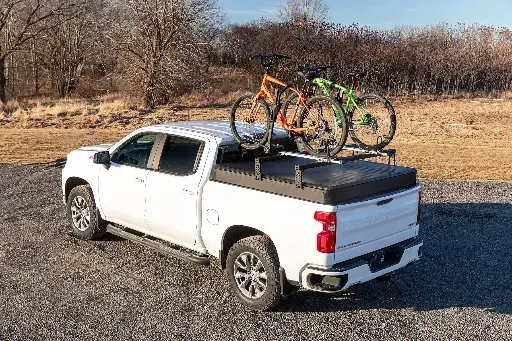
A bed rack is the opposite idea. Instead of enclosing the bed, it builds up and over it, giving you a platform to mount and haul gear above the bed floor.
Racks shine for a specific kind of owner:
- Long or bulky gear: Kayaks, lumber, ladders, and bikes ride up top.
- Stacking room: You use vertical space; the bed alone wastes.
- Open-bed feel: The bed underneath stays usable for other loads.
The catch is that a rack does nothing for weather or security on its own. Whatever rides up there is exposed, and the open bed below is still open. Racks also raise the overall height of the truck, which is not just a look. A taller profile can mean your truck no longer clears the home garage, the parking structure at work, or the drive-through, so measure your daily clearances before you commit. Some owners love the geared-up stance. For others, between the height and the exposure, it is a dealbreaker.
Truck Topper vs Bed Rack: Head to Head
Here is where the truck topper vs bed rack matchup stacks up against the jobs most owners care about. No spin, just how each one tends to perform.
- Tool hauling: A topper wins by keeping tools dry and locked. A rack wins on carrying oversized equipment that a shell could never hold.
- Weather protection: The topper takes this one easily. A rack leaves your gear out in it.
- Gear stacking: The rack takes this one. It opens up the vertical room a topper actually limits, since the shell caps how tall your load can be.
- Resale and flexibility: This matters more than most shoppers expect. A topper is a bolt-on shell that comes off if a buyer does not want it, but it is a two-person job, and the truck looks bare without it. A rack is a fixed structure that changes the whole stance of the truck, so it narrows your buyer pool to people who want that look. Both are real commitments. A raiser, by contrast, installs without drilling and reverses cleanly, which keeps the bed close to stock if you ever sell.
- Cost: Think in broad, typical ranges that move with the market, not fixed numbers. Toppers usually sit at the higher end because you are buying an enclosed shell, racks land across a wide middle depending on size and configuration, and a raiser sits between a bare cover and a full topper. No exact figure survives contact with a shifting market, so for the Maxify raiser, check the product page for current pricing rather than trusting any number quoted elsewhere.
Notice the pattern. A topper protects but limits. A rack expands but exposes. Most owners want a little of both, which is exactly why so many people get stuck on this decision in the first place.
The Third Option Most Comparisons Skip
Here is the part that the usual reviews leave out of the truck topper vs bed rack debate. You do not have to pick between sealing the bed off and building over it. There is a middle path that solves the storage problem without the tradeoffs of either one.
A bed raiser lifts your existing cover up and away from the bed floor, opening real vertical room underneath while keeping the cover you already have. You are not enclosing the bed like a topper, and you are not stacking everything on an exposed platform like a rack. You get more usable space, and you keep your bed access.
The Maxify Truck Bed Raiser attaches to your bed rails and pushes the cover up around 6 inches, which works out to about 25 percent more room on average. There is nothing to drill and nothing permanent to undo. The cover keeps its factory action, and a built-in locking tailgate member keeps whatever you stash down there secure. It is the in-between answer that plenty of owners want without realizing it already exists.
So, Which One Fits Your Truck?
Strip away the noise, and the choice comes down to what you haul and how often. Keep in mind that owner types shift with the seasons. The contractor hauling tools in November is often the camper loading coolers in July, and a setup that only suits one of those leaves you stuck the other half of the year. A quick gut check by owner type:
- You haul weather-sensitive gear and want it locked. A topper makes sense, as long as you can live with the limited access.
- You haul long, bulky gear and like the open-bed look. A rack fits as long as you are fine with leaving loads exposed.
- You want more room without sealing off or building over the bed. A bed raiser is the one to look at, since it keeps your cover and your access while opening up space.
Plenty of owners land in that third bucket once they see it laid out. They do not want a sealed box or a tall platform. They want their bed to hold more without giving anything up. If you have read this far and still feel torn, that is the sign.
A System You Can Build On
One more thing worth knowing. A raiser is not a single-purpose part, the way a topper or standalone rack tends to be. It is the foundation of a modular setup, so you start with more bed space and add to it as your needs change.
- Rackify Bed Rack System: Mount racks above the raised cover for the long gear that a topper has no room for.
- Accessories: Bed handles, tie-down anchors, load stops, and MOLLE plates all use the same hand-tightened hardware.
- Fitment: Models from the F150 and Tacoma to the Ram 1500 and Jeep Gladiator each have their own kit, matched to year and bed length. Use the bed length measuring walkthrough on the Truckify site to land on the right one.
That is the real advantage of the middle path in the truck topper vs bed rack question. You are not locked into one job. You build the bed around how you live.
Rethink Your Truck Bed
Stuck between a topper and a rack? That fence-sitting feeling usually means neither one is what you are after. Truckify came out of that exact frustration, built by people who haul for a living and for fun. Take a look at the Maxify raiser and everything that pairs with it, then pick the kit that matches your rig. Not sure yet? Drop the Truckify crew a line, and they will talk it through.
Frequently Asked Questions
Is a topper or a bed rack better for hauling tools?
It depends on the tools. A topper keeps smaller tools dry and locked out of sight, which suits anyone hauling power tools or anything that hates rain. A rack is better when your equipment is oversized and would never fit under a shell. If you want dry storage plus open room for the occasional big load, a bed raiser splits the difference by adding space under your existing cover.
Will a topper or rack hurt my fuel economy?
Both add mass and change how air moves around your truck, so either can affect mileage. A rack with gear up top tends to create more drag than an enclosed shell. A bed raiser sits low and works with your current cover, so it changes the profile far less than building up on and over the bed.
Can I add a rack later if I start with something else?
Yes, and that is one of the stronger arguments for starting with a raiser. Begin with the raiser for the extra room, then bolt on the Rackify rack later once a long-gear haul comes up. Since it all shares one mounting standard, adding to it never means starting over.
Which option keeps my bed accessible day to day?
This is where the three diverge most. A topper seals the bed, so you reach in through side hatches or the tailgate, and tall loads are out entirely. A rack leaves the bed open but parks gear overhead, so you load up high. A raiser keeps the cover working as it did from the factory and the tailgate clear, so daily access stays closest to a stock bed while you still gain room underneath.
Can I run a topper and a rack at the same time?
Some owners do, using a rack built to mount over a topper, but it is a tall, heavy, and costly combination that commits the truck fully to one configuration. If the appeal is dry storage plus overhead hauling, that is the exact gap a raiser-and-rack setup fills with less bulk. The raised cover handles the dry space, the rack handles the long gear, and you can check the supported covers list to confirm your cover works before ordering.